Friday, May 10, 2013

Signs of Joy: Infants with Thoughtful Hands

Based on Real Live Science!!
I have had a fascinating time researching how hearing children learn and can benefit from using American Sign Language. My toddler Amelie has been fulfilling and engaging to watch on her journey toward communication, using between 200 and 300 signs at almost 2 years old. Now that I am pregnant with her little sister Bodhi, I am having fun collecting ideas of what we can do differently to help the next baby learn as fully – and joyfully – as we can.  Experiential lessons coming soon...

The best book I've found on teaching babies sign focuses on teaching parents to cultivate learning moments, embroidering jointly sustained focus -- a parenting strategy shown in unrelated research to accelerate language acquisition, even when no signs are used at all.  If you read one book about signing with infants, I recommend Signing Smart with Babies and Toddlers by PhD'd moms Michelle Anthony and Reyna Lindert.

The rationale and methodology for using gestural language with preverbal infants are simple; the influence doing so has on cognitive development is so complex it defies scientific description (but then so do most functions of the mind and most other things it's hard to make money from). The rationale is both physiological and intuitive: babies have the motor coordination to intentionally gesture long before their articulatory tracts and neural development can create speech, so babies can express themselves and begin learning younger when they're taught a formal gestural code. If a baby can wave bye-bye, the baby can sign; teaching a baby to sign is as easy (and natural) as teaching a baby to blow kisses, it just makes the most of the nonverbal communication parents have always relied upon for solving problems with infants (albeit often unconsciously). By bringing the power of intentionality to the body as a medium of ideas, parents who teach infants sign language allow babies to identify needs or interests, to have a modicum of control over their lives, and the connection created by understanding usually lessens toddler frustration.

The methodology is basically to do exactly the same thing as when you wave bye-bye – to pair a gesture with an event (and a spoken word) repeatedly, and to respond with joyous encouragement to a baby's every effort at participation. Ideas abound for how to do this in effective ways, but there are several basic guidelines.

  1. When to start: Signing can begin as early as parents want to start practicing but a baby will not sign back until they have the motor control to imitate hand and arm movements, usually around 7 months old. (With Amelie we began signing 'more' and 'milk' at about 5 months, though she did not produce signs herself until late, around 9 or 10 months old; I intend to start with Bodhi in a focused way at about 4 months, in the hopes that using specific teaching strategies will encourage her to produce signs earlier than Amelie did.) We expose babies to speech from the minute they are born with no concern for confusing overstimulation, so the only danger of signing early is parental disillusionment if the infant does not return the favor fast enough. A baby over the age of 8 months can be expected to begin signing within 3 or 4 weeks; toddlers a year and older will often start the same day. Interestingly, spoken language systematically blossoms very shortly after 3 or 4 signs have been mastered (Anthony and Lindert). Signing is a well-tested strategy for accelerating language development for children with speech delays.

  2. What to teach first: the consensus is to begin with only a few signs (ranging from 3 to 6) and wait until the baby begins to use them before broadening the vocabulary. Spoken language is presented in a very complex stream, so the idea is to use signs to highlight simple ideas within that stream rather than introducing an entire secondary code requiring interpretation. When used this way, signs are taught for individual words, not couched in an environment of true language (as is American Sign Language, which requires complex syntax); this is why some sources caution against the term “baby sign language” (Brenda Seal, 2010). Some approaches advise balancing useful, parent-motivated signs (like 'more,' 'milk' and 'food' as suggested by Joseph Garcia in the first ASL-based babysign classic Sign with your Baby) with fun, baby-motivating signs (like 'bear', 'dog' and 'ball' as suggested by Anthony and Lindert again). When the baby begins to produce available signs, follow the baby's attention to decide what new signs are called for, and increase the vocabulary in a child-directed progression. Signs can be modified for ease of use (as advised by seminal researchers Linda Acredolo and Susan Goodwyn in Baby Sign) but children will pronounce even 'easy' movements in their own unique ways, so most methodologies now advocate the use of formal ASL signs instead of homemade ones. Using 'real' signs makes it easier to remember what was used, easier to teach new caretakers, and easier to pair speech with simultaneous sign.  Many of Acredolo and Goodwyn's suggested modified signs require the use of the mouth in some way, like opening it for hippopotamus or sniffing for flower, which precludes presentation of the word at the same time. I use ASL with Amelie because it's a 2nd language for her; I also sign sometimes without speaking at all for the same reason, against the advice of speech-pathologists, and was surprised to read Joseph Garcia's endorsement of the behavior as a technique to focus a child's mind on the sufficiency of sign to carry meaning.
  3. How to introduce signs: Most simply, just make the gesture when you say the word, as you do with waving bye-bye. More effectively, sign near your face (Garcia) so it is in the baby's line of sight, and do so either right before, during, or after the sign is relevant. (If you're driving through the countryside and sign 'cow' while one whizzes past, the baby may think you're referring to fields or something still visible when she looks out the window.) A fantastic source for tricks about how to capture effective learning moments can be found in Signing Smart (Anthony and Lindert), which gives tips about how to teach signs while reading books together (like to sign directly on the picture) or while holding a baby in your lap (like to sign on the baby's body yourself).

    Tons more to come on this topic, but the most important part of all: have fun.  The point is joy.  We learn better happy; we live better happy.  Let me know what works for you!

Tuesday, June 12, 2012

Daddy Brain: Sniff and Grow??

Brian's Facebook caption: "I was already a father, but now I'm a Dad."
"For a guy to set aside the sports car and man up to a minivan, his brain must surely have revised its circuitry. Indeed, neural modifications nudge him toward nurturing behaviors."  So begins How Dads Develop (Mossop, 2011), a fascinating Scientific American Mind article summarizing research about the neural impact of newborn fatherhood.

One under-spoken gem of neurological research?  Fathers experience a rush of new brain cell growth when they take care of their newborns.  Not only is there a heavy re-wiring of existing neurons, there is also a sudden sprouting of new ones, particularly those concentrated in the olfactory bulb (processing smell) and the hippocampus (consolidating memories).  Research with mice shows that a father recognizes his pups based on their smell because when they were born his brain sprouted bunches of neurons to specifically encode their smells like names.  The memories seem to be stronger because new neurons are sprouted for them instead of re-wiring old ones.

It only works if daddy mice take care of their babies, though.  When a mesh screen was placed between fathers and pups so fathers could only smell them, no new neurons grew, and fathers didn't recognize pups as adults.  The hormone prolactin (best known for signaling the release of milk in breastfeeding mothers) is elevated when fathers care for offspring, and the elevated prolactin stimulates brain growth.

In mice.  Unfortunately far less research has been done on human fathers, and none (according to Google Scholar) regarding adoptive parents.  The research cited here is from Paternal recognition of adult offspring mediated by newly generated CNS neurons (Mak & Weiss, 2010).  But the mouse brain is a good enough model of the human brain to justify hundreds of thousands of rodent experiments, so very likely the moral holds: so long as fathers take care of their babies, those infants inspire and sculpt a little more Daddy brain -- and taking a good sniff of that sweet infant smell (being careful which end you choose) may just be what it's all about.

Thursday, May 31, 2012

Harder than childbirth? Sure! Comparable? Nope

Warning: this is a scienceless, opinionated post.  I recently described childbearing as an adventure so singular that going on a research mission to Antarctica, while a good adventure for a man, doesn't hold a candle to pregnancy and birth.  A reader respectfully contributed the following feedback: "It can be the most difficult thing you do, physically. But there are physically harder things and physically more painful things too. You don't have to be a female to experience them."

A parallel experience to childbirth? Uh, if you loved it.
I agree -- there are definitely experiences both more physically challenging and more painful that remain available to the roughly 65% of humans who can't or don't want to give birth to a baby [please let me know if you can find facts on that percentage; I can't].  Getting driven through the bush in Ghana by a crazy man with a machete, that was scarier.  Sitting on bags of what felt like cement in the exposed back of a cargo truck with no shade for two days traveling to Tomboctou on rutted sandy roads, that approximated the discomfort of the last two or three weeks of pregnancy.  I've never climbed Everest or sawed my arm off in a canyon with a pocketknife but I suspect those stack up rather well to squeezing an infant out your hoohaa.

My point is not that women win the hard/painful contest, and it certainly is not that we should be pitied for our sacrifice -- that's the perspective of the Belly Laughs book that pisses me off so much.  We don't deserve to be pitied: we do deserve to be envied.

Let's entirely disregard all fodder for martyrdom, all suffering and exertion inherent in the process of pregnancy and birth.  While other experiences may be more challenging, the experience of creating and sustaining something alive inside you is weird, trippy, disconcerting -- and heady, hypnotic, absolutely mystic when you feel movement begin, when you sense excitement in response to Daddy's voice (or Natural Language Processing as with Amelie).  Sparking life inside you and becoming a conduit of consciousness is enviable because it's empowering, exhilarating, and really, really strange -- plus once the baby's out it's deeply gratifying to amplify your influence in the world.

Please do pardon my unscientific digressions.  As with being a graduate student, being a mother doesn't get the positive press it deserves (they're both a lot more fun than they seem).  We'll be back to opinionless facts next post I promise.  For now, happy parenting.  Be proud.

Wednesday, May 30, 2012

Horrid Anti-recommended Reading #1: Belly Laughs

DO NOT READ THIS CRAP.
Don't get me wrong: I have nothing against big boobs.  As a credential for authorship of a book about pregnancy however Jenny McCarthy's looks fall drastically short. 

It is not the over-generalizing lack of scientific rigor that lands this piece of tripe at the top of my shit list, nor is it even the lowest-common-denominator prose.

It's the sniveling. Belly Laughs is 165 pages of victimization, casting the ardors of pregnancy as a pitiable and atrocious burden.

The whole book is a series of poor-me anecdotes.  And pregnancy is really frigging hard, don't get me wrong there either.  Every day is truly replete with new and surprising discomforts, such as gums that bleed more when we brush our teeth because of the increase in blood vessels all over the body or shoes that no longer fit because the hormone relaxin causes all tendons to loosen up and spread out, especially weight-bearing ones (Mayo Clinic Guide to a Healthy Pregnancy, 2004).

Nothing in the spectrum of human experience compares to the adventure of gestating a self-perpetuating exothermic ball of multiplying energy, with the sole and extremely notable exception of grunting through the impossibly herculean gauntlet of getting that human out of you.  In the months after I gave birth a good male friend of mine told me he was trying to go on a research mission for half a year to Antarctica, and I distinctly remember thinking "That's a pretty good adventure, for a man."  It's hard to be brave enough to reproduce the human race.

This book does nothing but make it harder.  Jenny treats stretch marks as though they were disgusting and shameful things we should be terribly disappointed we can't erase when they are in fact (pardon my cheese here but I believe this) our hard-won badges of heroic bravery, proof we have done something amazingly difficult for which we deserve pure admiration.  The one good thing about the pile of drivel that is Belly Laughs is that it polarized my drive to find a writer who understood pregnancy as empowering, and I searched until I found it -- but that's another post.

Sunday, May 27, 2012

For Sarah Becker: **Kiss me! I'm contracting**

Ina May, the queen of hippie midwifery
Kissing during labor may seem like an entirely counter intuitive (or even horrid) idea, but hippies have been enjoying the love-it-up strategy for a long time.  World reknowned midwife and writer Ina May Gaskin recommends it along with nipple stimulation to help labor progress (Ina May's Guide to Childbirth by Ina May Gaskin, 2003).  The key seems to be in the routinely over-hyped and misunderstood neuropeptide oxytocin, which is the naturally occurring form of the drug Pitocin that is piped into women's veins to speed the arrival of hesitant newborns.  Research with 45 laboring women showed that while nipple stimulation triggered regular uterine activity (three contractions within 10 minutes) more rapidly than Pitocin did, nipple-inspired contractions were less powerful, and the study finally concluded that the two types of stimulation were doing significantly different things (Comparison of uterine activity induced by nipple stimulation and oxytocin by Mashini et al, 1987).

What does the research have to say about kissing?  Not much -- and if you disqualify testimony or anecdotal accounts, nothing.  Apparently no one has gotten a kiss/don't kiss experimental protocol past the Human Resource Council or the Internal Review Board.

I can tell you the juice on it from my own experience, but be forewarned, this is not science: I am one person and my experience is not significantly predictive of anyone else's.  Kissing absolutely worked to make contractions less painful or less stressful.  The pressure of a building contraction would suddenly melt away, exactly as if a water balloon filled almost to bursting was suddenly opened at the spout part so extra water could come out again.  But it only felt that way IF I was pretty much mashing my mouth against Brian's with something akin to the force of the contraction.  We did this sporadically for 8 hours of Pitocin-induced contractions until I was at 7cm dilation, so we're not talking pecks on the cheek here; it was certainly fun, but it wasn't sexy at all, and he remembers it as being rather painful.

It seems that the whole have-sex-to-trigger-labor game may involve oxytocin as well, but that might also be a matter of semen-borne prostoglandins dissolving cervical tissue.  That's another post though.  For now if you're curious about the big O of birth, check out this myth-busting article by Heather Corrina in Scarleteen:
Myths about the "love hormone" oxytocin that could ruin your love life.

And to the godmother of my own little cherubic captor Amelie, to Sarah Becker who was due three days ago and is still waiting... whether you get into the hippie kissy stuff or not, here's hoping you have one sweet psychedelic ride on the love slide of birth.  I'll see you and your little one on the other side.

Saturday, May 26, 2012

What the frigging heck? Birth predicts handwriting!?

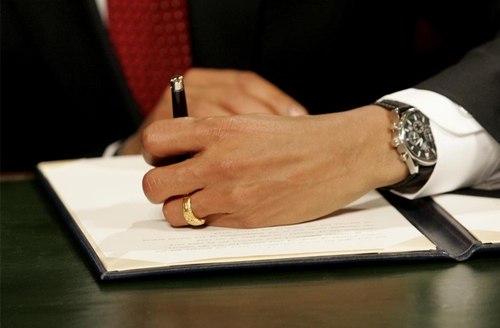
I'd guess Obama had a complicated birth.
Completely baffling gem: a study of 1,203 people concluded that birth complications raise the likelihood that the baby will eventually hold a pencil pointing toward himself (inverted) when he writes!  The effect is most pronounced in left-handed males ("The relationship between birth stress and writing hand posture" by Searleman, 1982).  Uhhh... what the heck?  The only logical tie I can imagine is that conditions causing birth complications might also correlate with neural... um...

Crap, I have no idea.  Weird.


Newborns can taste your voice!

New fascinating finding from the labs of developmental neuroscience: all babies start out with synesthesia, a melding of senses in which stimulation of one sense or modality is experienced as stimulation of other senses as well. Many adults retain the trait of being able to "see" sound or even "taste" emotion. An infant begins life with intermingled senses because his brain is one big interconnected glob; he has far more neurons than at any other point in his life and more than twice the number of connections between them than he'll ever have again. This massive recursivity of neural connections usually dies off by 8 months through a process of neural pruning, resulting in the discrete sensory processing most adults experience.

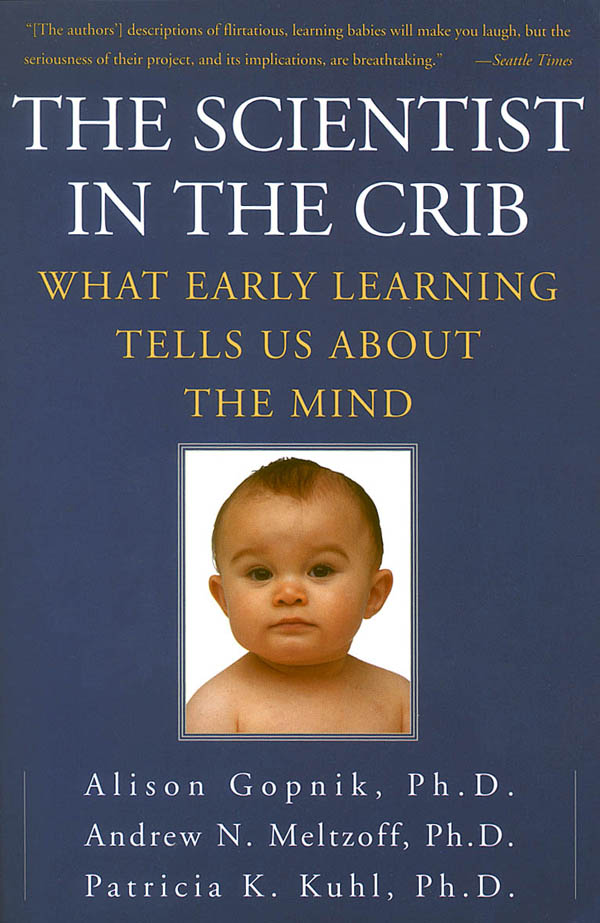
Now the totally amazing thing: people on the autistic spectrum seem to miss the heavy bonsai-like neural pruning most infants go through before they turn one year old. Autistic brains are wired far more heavily than other people's; the cognitive trouble is caused not by a lack of brain cells or communication between them but instead by a surplus. Too much connection prevents any one pathway from "winning out" and that prevents associations from being made, which means the brain can't shape itself around experiences the way most brains can; there can be no formation of consistent patterns (learning). Adults with synesthesia seem to have hit the sweet spot between us mere mortals and the autistic spectrum. So is my understanding anyway, based on sources such as "Preverbal Infants’ Sensitivity to Synaesthetic Cross-Modality Correspondences" by Walker et al (2010), "Infants Possess Intermingled Senses:Babies are born with their senses linked in synesthesia" by Maria Konnikova in Scientific American Mind, and The Scientist in the Crib: Minds, Brains, and how Children Learn (2009) by Gopnik et al.