Thursday, May 31, 2012

Harder than childbirth? Sure! Comparable? Nope

Warning: this is a scienceless, opinionated post.  I recently described childbearing as an adventure so singular that going on a research mission to Antarctica, while a good adventure for a man, doesn't hold a candle to pregnancy and birth.  A reader respectfully contributed the following feedback: "It can be the most difficult thing you do, physically. But there are physically harder things and physically more painful things too. You don't have to be a female to experience them."

A parallel experience to childbirth? Uh, if you loved it.
I agree -- there are definitely experiences both more physically challenging and more painful that remain available to the roughly 65% of humans who can't or don't want to give birth to a baby [please let me know if you can find facts on that percentage; I can't].  Getting driven through the bush in Ghana by a crazy man with a machete, that was scarier.  Sitting on bags of what felt like cement in the exposed back of a cargo truck with no shade for two days traveling to Tomboctou on rutted sandy roads, that approximated the discomfort of the last two or three weeks of pregnancy.  I've never climbed Everest or sawed my arm off in a canyon with a pocketknife but I suspect those stack up rather well to squeezing an infant out your hoohaa.

My point is not that women win the hard/painful contest, and it certainly is not that we should be pitied for our sacrifice -- that's the perspective of the Belly Laughs book that pisses me off so much.  We don't deserve to be pitied: we do deserve to be envied.

Let's entirely disregard all fodder for martyrdom, all suffering and exertion inherent in the process of pregnancy and birth.  While other experiences may be more challenging, the experience of creating and sustaining something alive inside you is weird, trippy, disconcerting -- and heady, hypnotic, absolutely mystic when you feel movement begin, when you sense excitement in response to Daddy's voice (or Natural Language Processing as with Amelie).  Sparking life inside you and becoming a conduit of consciousness is enviable because it's empowering, exhilarating, and really, really strange -- plus once the baby's out it's deeply gratifying to amplify your influence in the world.

Please do pardon my unscientific digressions.  As with being a graduate student, being a mother doesn't get the positive press it deserves (they're both a lot more fun than they seem).  We'll be back to opinionless facts next post I promise.  For now, happy parenting.  Be proud.

Wednesday, May 30, 2012

Horrid Anti-recommended Reading #1: Belly Laughs

DO NOT READ THIS CRAP.
Don't get me wrong: I have nothing against big boobs.  As a credential for authorship of a book about pregnancy however Jenny McCarthy's looks fall drastically short. 

It is not the over-generalizing lack of scientific rigor that lands this piece of tripe at the top of my shit list, nor is it even the lowest-common-denominator prose.

It's the sniveling. Belly Laughs is 165 pages of victimization, casting the ardors of pregnancy as a pitiable and atrocious burden.

The whole book is a series of poor-me anecdotes.  And pregnancy is really frigging hard, don't get me wrong there either.  Every day is truly replete with new and surprising discomforts, such as gums that bleed more when we brush our teeth because of the increase in blood vessels all over the body or shoes that no longer fit because the hormone relaxin causes all tendons to loosen up and spread out, especially weight-bearing ones (Mayo Clinic Guide to a Healthy Pregnancy, 2004).

Nothing in the spectrum of human experience compares to the adventure of gestating a self-perpetuating exothermic ball of multiplying energy, with the sole and extremely notable exception of grunting through the impossibly herculean gauntlet of getting that human out of you.  In the months after I gave birth a good male friend of mine told me he was trying to go on a research mission for half a year to Antarctica, and I distinctly remember thinking "That's a pretty good adventure, for a man."  It's hard to be brave enough to reproduce the human race.

This book does nothing but make it harder.  Jenny treats stretch marks as though they were disgusting and shameful things we should be terribly disappointed we can't erase when they are in fact (pardon my cheese here but I believe this) our hard-won badges of heroic bravery, proof we have done something amazingly difficult for which we deserve pure admiration.  The one good thing about the pile of drivel that is Belly Laughs is that it polarized my drive to find a writer who understood pregnancy as empowering, and I searched until I found it -- but that's another post.

Sunday, May 27, 2012

For Sarah Becker: **Kiss me! I'm contracting**

Ina May, the queen of hippie midwifery
Kissing during labor may seem like an entirely counter intuitive (or even horrid) idea, but hippies have been enjoying the love-it-up strategy for a long time.  World reknowned midwife and writer Ina May Gaskin recommends it along with nipple stimulation to help labor progress (Ina May's Guide to Childbirth by Ina May Gaskin, 2003).  The key seems to be in the routinely over-hyped and misunderstood neuropeptide oxytocin, which is the naturally occurring form of the drug Pitocin that is piped into women's veins to speed the arrival of hesitant newborns.  Research with 45 laboring women showed that while nipple stimulation triggered regular uterine activity (three contractions within 10 minutes) more rapidly than Pitocin did, nipple-inspired contractions were less powerful, and the study finally concluded that the two types of stimulation were doing significantly different things (Comparison of uterine activity induced by nipple stimulation and oxytocin by Mashini et al, 1987).

What does the research have to say about kissing?  Not much -- and if you disqualify testimony or anecdotal accounts, nothing.  Apparently no one has gotten a kiss/don't kiss experimental protocol past the Human Resource Council or the Internal Review Board.

I can tell you the juice on it from my own experience, but be forewarned, this is not science: I am one person and my experience is not significantly predictive of anyone else's.  Kissing absolutely worked to make contractions less painful or less stressful.  The pressure of a building contraction would suddenly melt away, exactly as if a water balloon filled almost to bursting was suddenly opened at the spout part so extra water could come out again.  But it only felt that way IF I was pretty much mashing my mouth against Brian's with something akin to the force of the contraction.  We did this sporadically for 8 hours of Pitocin-induced contractions until I was at 7cm dilation, so we're not talking pecks on the cheek here; it was certainly fun, but it wasn't sexy at all, and he remembers it as being rather painful.

It seems that the whole have-sex-to-trigger-labor game may involve oxytocin as well, but that might also be a matter of semen-borne prostoglandins dissolving cervical tissue.  That's another post though.  For now if you're curious about the big O of birth, check out this myth-busting article by Heather Corrina in Scarleteen:
Myths about the "love hormone" oxytocin that could ruin your love life.

And to the godmother of my own little cherubic captor Amelie, to Sarah Becker who was due three days ago and is still waiting... whether you get into the hippie kissy stuff or not, here's hoping you have one sweet psychedelic ride on the love slide of birth.  I'll see you and your little one on the other side.

Saturday, May 26, 2012

What the frigging heck? Birth predicts handwriting!?

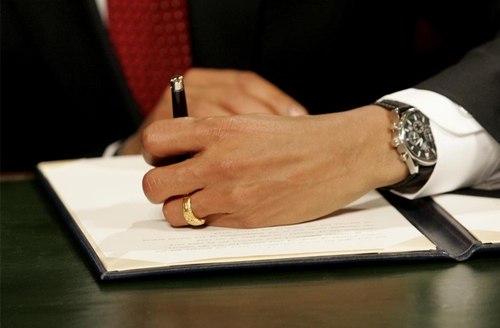
I'd guess Obama had a complicated birth.
Completely baffling gem: a study of 1,203 people concluded that birth complications raise the likelihood that the baby will eventually hold a pencil pointing toward himself (inverted) when he writes!  The effect is most pronounced in left-handed males ("The relationship between birth stress and writing hand posture" by Searleman, 1982).  Uhhh... what the heck?  The only logical tie I can imagine is that conditions causing birth complications might also correlate with neural... um...

Crap, I have no idea.  Weird.


Newborns can taste your voice!

New fascinating finding from the labs of developmental neuroscience: all babies start out with synesthesia, a melding of senses in which stimulation of one sense or modality is experienced as stimulation of other senses as well. Many adults retain the trait of being able to "see" sound or even "taste" emotion. An infant begins life with intermingled senses because his brain is one big interconnected glob; he has far more neurons than at any other point in his life and more than twice the number of connections between them than he'll ever have again. This massive recursivity of neural connections usually dies off by 8 months through a process of neural pruning, resulting in the discrete sensory processing most adults experience.

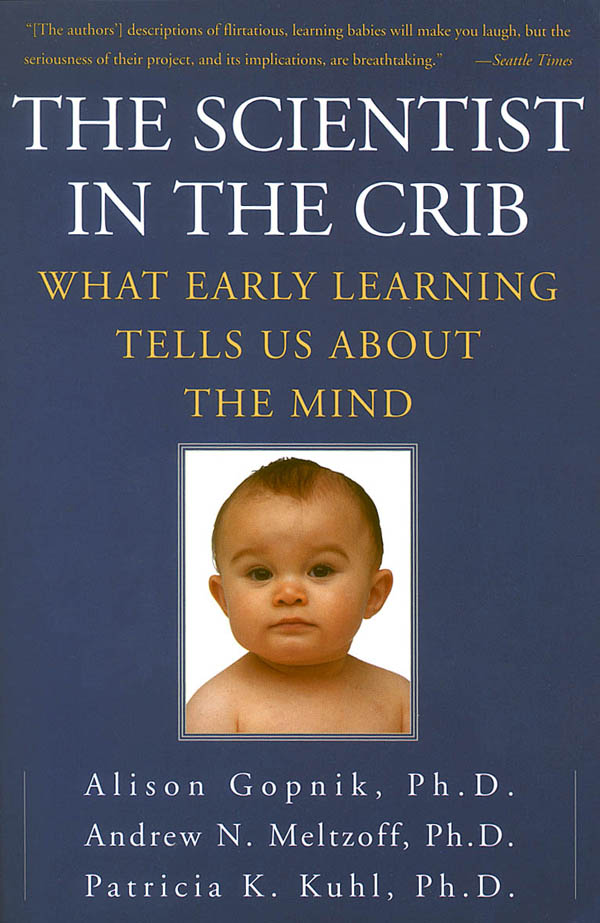
Now the totally amazing thing: people on the autistic spectrum seem to miss the heavy bonsai-like neural pruning most infants go through before they turn one year old. Autistic brains are wired far more heavily than other people's; the cognitive trouble is caused not by a lack of brain cells or communication between them but instead by a surplus. Too much connection prevents any one pathway from "winning out" and that prevents associations from being made, which means the brain can't shape itself around experiences the way most brains can; there can be no formation of consistent patterns (learning). Adults with synesthesia seem to have hit the sweet spot between us mere mortals and the autistic spectrum. So is my understanding anyway, based on sources such as "Preverbal Infants’ Sensitivity to Synaesthetic Cross-Modality Correspondences" by Walker et al (2010), "Infants Possess Intermingled Senses:Babies are born with their senses linked in synesthesia" by Maria Konnikova in Scientific American Mind, and The Scientist in the Crib: Minds, Brains, and how Children Learn (2009) by Gopnik et al.

Thursday, May 24, 2012

Recommended Reading #1: The Science of Parenting

My favorite parenting book
If you read only one book about what research implies for loving parents, Margot Sunderland's The Science of Parenting (2006) is your best bet.  Well-illustrated and clear to read, it is full of surprising findings from long-term neurological and psychological studies.

I learned that a newborn's half-baked nervous system depends on an adult's steady, calm one in the same way her immature immune system relies on a mother's milk for antibodies, which may partially account for the fact that "cultures practicing the highest cosleeping and bed-sharing rates experienced... the lowest SIDS rate of all." (Studies cited in Jackson (1999), Three in a bed: The benefits of sleeping with your baby)

I also learned that the two types of tantrums, Little Nero vs. Distress, are best treated with opposite reactions on the part of the parent.  A distress tantrum, in which a child is too distressed or sad to communicate clearly, needs to be treated gently by a parent to bolster a child's ability to process her own emotions.  A Little Nero tantrum, in which a child angrily continues to manipulate and insist that she be obeyed, is best ignored.  ADHD and sibling rivalry are also discussed.  This book's fun to read when you're pregnant and very useful for years afterward.

Wednesday, May 23, 2012

Welcome!

Conflicting advice is the bane of the literate parent in America these days, but most of the questions that get answered so many different ways have actually been rigorously tested.  If you're looking for solid evidence with which to make parenting decisions, you've found it.

Topics will include conception, pregnancy, birth, feeding, sleeping, care and development.  Please post requests when there is a question you want me to research. Every post will cite at least one source of information so you can look deeper and learn more.

We parents today are the first generation to have facts at our fingertips instead of having to depend on cultural folklore, as Meridith Small describes beautifully in the ethnopediatric review of Our Babies, Ourselves.  We can decide what's best for our children based not on what our parents did or what others tell us.  We can make our own decisions using facts others have worked hard to discover.

Let's do.   We want our kids to do our grandkids the same favor, right?